
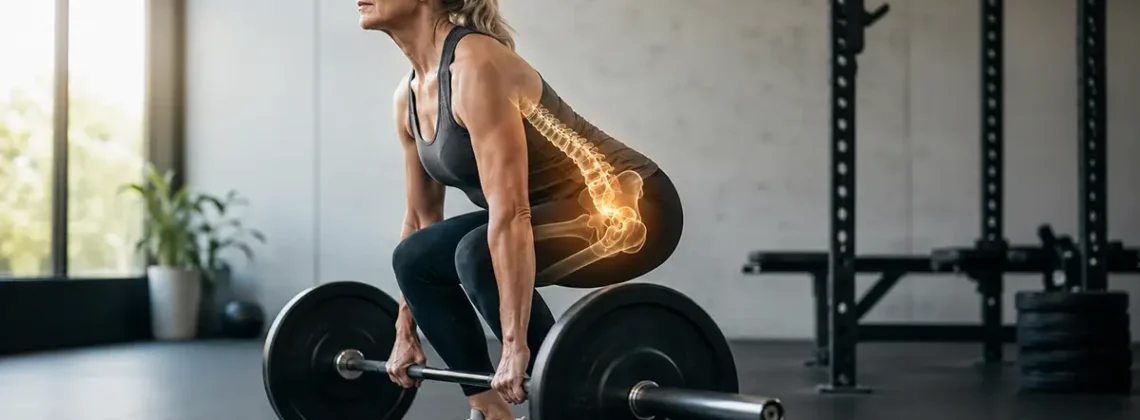
The largest review ever conducted finds that calcium and vitamin D do almost nothing to prevent fractures in most older adults. The evidence points instead toward the barbell.
By John E. Lewis, Ph.D.
Voluntary Associate Professor, University of Miami Miller School of Medicine
Founder and President, Dr Lewis Nutrition®
Your skeleton is the literal framework of your independence, and the slow loss of bone strength is one of the quiet events that decides whether the later decades of life are lived on your own terms. Hip and spine fractures are not minor inconveniences. They mark, for a great many older adults, the beginning of lost mobility, lost autonomy, and in too many cases a shortened life. For more than thirty years, the standard advice handed to aging men and women has been simple and reassuring, namely that you should take your calcium, add a little vitamin D, and trust that your bones will hold. Millions of people have followed that advice faithfully, and the supplement industry has earned billions of dollars selling it to them. I would argue, on the basis of the most rigorous evidence now available, that the advice was largely wrong, and that the money and the faith invested in those supplements could have been directed toward something that actually works.
When the Evidence Caught Up: What the New BMJ Review Reveals
In May of 2026, The BMJ published the largest and most carefully designed review of this question ever assembled. Massé and colleagues pooled sixty-nine randomized controlled trials comprising 153,902 participants, and they asked a deceptively simple question, which is whether calcium, vitamin D, or the two combined actually prevent the fractures and falls that they are so widely prescribed to prevent.1 The answer, for the overwhelming majority of older adults living independently in the community, was no. Calcium alone produced no clinically meaningful reduction in fracture or fall risk. Vitamin D alone produced no clinically meaningful reduction. In the case of vitamin D, one of the likely limitations of the research is not acknowledging that vitamin D3 (the superior supplemental form to vitamin D2) should be combined with vitamin K2 to get the synergistic effect of assisting calcium’s assimilation into the bones. Even the combination of the two, long regarded as the gold-standard regimen, showed only a faint statistical flicker toward fewer fractures; a signal so small that it failed to cross the threshold the researchers had defined in advance as meaningful to an actual human life.1
What makes this review so difficult to dismiss is the standard it applied. Most earlier studies reported their results as relative risk ratios, a format that can make a trivial benefit appear impressive, since a fall in fracture incidence from two percent to one and eight-tenths percent becomes a relative reduction of roughly nine percent even though the true absolute benefit is less than two-tenths of a single percentage point. The 2026 review instead required supplements to demonstrate a meaningful absolute reduction, which is the real-world drop in the number of people who actually break a bone, and on that honest measure the supplements did almost nothing.1
This conclusion did not arrive in isolation. It is the latest and largest confirmation of a pattern that careful researchers have been documenting for more than a decade. Bolland and colleagues, in a 2015 systematic review also published in The BMJ, found that dietary calcium intake bears no consistent relationship to fracture risk, and that the evidence for supplements preventing fractures was weak and inconsistent.2 Even more sobering, the same group had earlier shown, in a 2010 meta-analysis, that calcium supplements taken without vitamin D were associated with a meaningful increase in the risk of myocardial infarction (i.e., the common heart attack).3 In other words, the supplements that were supposed to protect the skeleton not only failed at that task for most people, but in at least one widely used formulation carried a measurable cost to the heart.
I want to be precise here because precision is the entire point. The 2026 review did not examine people with diagnosed osteoporosis under active medical treatment, nor people with confirmed vitamin D deficiency, nor those with specific medical conditions for which a clinician has sound reason to recommend supplementation.1 For those individuals, calcium and vitamin D may remain genuinely appropriate, and no one should abandon a physician’s considered plan on the strength of a single article. The finding that matters for the general population is narrower and more damning, which is that for the tens of millions of ordinary older adults who take these supplements every morning as a kind of insurance policy against the future, the policy does not pay out.
Supplements Versus Plates: Why Bone Responds to Load, Not to Logistics
To understand why the supplements fail, you must first understand what bone actually is. Bone is not an inert mineral scaffold that simply needs more raw calcium poured into it, in the way that you might top off a fuel tank. Bone is living, dynamic tissue, constantly being broken down and rebuilt by specialized cells, and the single most powerful signal that instructs those cells to build is mechanical force. More than a century ago the anatomist Julius Wolff observed that bone adapts its architecture to the loads placed upon it, a principle now known as Wolff’s law. In our own era, the physiologist Harold Frost refined this insight into what he called the mechanostat (i.e., a tissue-level feedback system in which bone senses the strain it experiences and adjusts its strength accordingly).4 The crucial detail, and the one that explains the failure of the supplement strategy, is that bone adds strength only when the strain it experiences exceeds a certain osteogenic threshold (i.e., the level of mechanical strain above which the building of new bone is switched on). Loads beneath that threshold maintain what already exists, at best. Only high-magnitude loads, applied at a meaningful rate, activate the machinery of new bone formation.4
This is precisely why the well-meaning advice to stay active by walking or jogging, while excellent for the heart and the mind, does so little for the aging skeleton. First, walking generates strains that are simply too low to cross the osteogenic threshold in the hip and spine of an older adult whose bones adapted long ago to the ordinary demands of upright locomotion. Second, the repetitive and low-intensity nature of most cardiovascular exercise sends the bone a signal that it has already accommodated, and living tissue does not invest scarce resources in building strength that it is not being asked to provide. Third, no quantity of calcium circulating in the bloodstream can substitute for the absent mechanical command because calcium is the building material and not the blueprint, and a pile of bricks does not assemble itself into a wall without an architect to issue the instructions. As I often say, a sugar is not a sugar, and in the very same spirit, a unit of exercise is not a unit of exercise because the kind of load placed upon the skeleton matters far more than the sheer quantity of movement.
Heavy resistance training supplies exactly the signal that walking cannot. When you brace a loaded barbell across your shoulders and stand up out of a squat, or drive a heavy weight overhead, you generate the very high-magnitude strain that the mechanostat is waiting to detect, and you generate it in the bones, including the spine and the hip, that fracture most catastrophically in later life. The most compelling demonstration of this principle is the LIFTMOR trial, conducted by Watson and colleagues in Australia and published in the Journal of Bone and Mineral Research in 2018.5 The investigators recruited postmenopausal women with low bone mass, the very population that conventional wisdom warns away from heavy lifting for fear of fracture, and randomized them either to eight months of brief, twice-weekly, supervised high-intensity resistance and impact training, or to a gentle home-based program of the sort usually recommended to such patients. The lifting group performed the deadlift, the back squat, and the overhead press, progressing to five sets of five repetitions at more than eighty-five percent of their maximum capacity. The results overturned decades of caution. The women who lifted heavy significantly increased their bone mineral density at both the lumbar spine (i.e., the lower back) and the femoral neck (i.e., the upper region of the thigh bone where the most dangerous hip fractures occur), improved their measures of strength and balance, and, contrary to the fears that had kept this very research from being conducted for so long, did so safely.5 The intervention that the establishment had assumed would break these women instead rebuilt them.
The Senior’s Playbook: A Safe and Sensible Path to the Barbell
I recognize that the phrase heavy resistance training can sound alarming to a man or woman in his/her sixties or seventies who has never set foot inside a gym, so allow me to be clear about how this is done responsibly. First, begin with your physician because anyone with diagnosed osteoporosis, established cardiovascular disease, uncontrolled blood pressure, or significant joint disease should obtain medical clearance before starting and should specifically mention the intention to perform loaded, compound movements. Second, invest in instruction before you invest in intensity because the single most important feature of the LIFTMOR protocol was that every session was supervised, and that its first month was devoted entirely to learning the movement patterns with light loads before any heavy weight was attempted.5 A qualified trainer or physical therapist who genuinely understands progressive resistance training is not a luxury in this context, but rather the difference between a safe program and an avoidable injury. Third, master the fundamental compound lifts, namely the squat, the deadlift, and the overhead press, because these are the movements that load the spine and the hip directly and recruit the large muscle groups that transmit force into the skeleton. Fourth, train heavily but briefly, because the osteogenic stimulus does not require punishing marathon sessions, and the LIFTMOR participants trained for only thirty minutes, twice each week, a modest dose that was nonetheless sufficient to reverse bone loss.5 Fifth, progress slowly and deliberately, adding weight only as your strength and your confidence grow, and never sacrifice sound form for the sake of a larger number on the bar.
A word on calcium itself is warranted because I am not arguing that the mineral is unimportant. Also, I work in the dietary supplement industry, and I take especially important supplements every day, so my position in this article should in no way make me an opponent of dietary supplements. Calcium is essential to the body and so is vitamin D. My argument is that the supplement is the wrong delivery system for most people. Obtain your calcium from whole foods, where it arrives accompanied by the full complement of cofactors that the human body evolved to use, from sources such as leafy green vegetables, strawberries, tomatoes, beans, tofu, almonds, sesame seeds, and tahini. Obtain your vitamin D from sensible sun exposure and, where a blood test reveals a true deficiency, with the targeted guidance of your clinician. If you live in northern latitudes or areas where it is cloudy and/or cold most of the year, then vitamin D3 (in combination with vitamin K2) should be strongly considered, not just for bone health, but overall health. Then give your skeleton the one input that no supplement on any shelf can provide, which is the mechanical demand to grow stronger.
The evidence has now spoken with unusual clarity, and it asks us to surrender a comfortable habit in favor of a more demanding truth. For more than thirty years we assured aging adults that bone strength could be purchased in a bottle, and the most rigorous review ever conducted has confirmed that, for most of them, it cannot. The good news is far more empowering than the myth it replaces. Your bones will respond, at nearly any age, to being asked to perform demanding work, and the asking costs nothing more than effort and competent instruction. If you are an older adult who has been dutifully taking calcium in the sincere belief that it protects you, I would encourage you to redirect that faith toward something that the science genuinely supports. Learn to lift, learn to lift with correct form, and learn to lift heavily enough that your skeleton is given a reason to rebuild itself. Your independence in the decades ahead may well depend upon it, and unlike the supplements, this is one prescription that grows stronger every single time you fill it.
Endnotes
1. Massé O, Mercurio CM, Dupuis S, Al Sahwi M, Arruda A, Dallaire G, Desforges K, Dugré N, Williamson D. Calcium, vitamin D, or combined supplementation to prevent fractures and falls: systematic review and meta-analysis. BMJ. 2026;393:e088050. doi:10.1136/bmj-2025-088050.
2. Bolland MJ, Leung W, Tai V, Bastin S, Gamble GD, Grey A, Reid IR. Calcium intake and risk of fracture: systematic review. BMJ. 2015;351:h4580. doi:10.1136/bmj.h4580.
3. Bolland MJ, Avenell A, Baron JA, Grey A, MacLennan GS, Gamble GD, Reid IR. Effect of calcium supplements on risk of myocardial infarction and cardiovascular events: meta-analysis. BMJ. 2010;341:c3691. doi:10.1136/bmj.c3691.
4. Frost HM. Bone’s mechanostat: a 2003 update. Anat Rec A Discov Mol Cell Evol Biol. 2003;275(2):1081-1101. doi:10.1002/ar.a.10119.
5. Watson SL, Weeks BK, Weis LJ, Harding AT, Horan SA, Beck BR. High-intensity resistance and impact training improves bone mineral density and physical function in postmenopausal women with osteopenia and osteoporosis: the LIFTMOR randomized controlled trial. J Bone Miner Res. 2018;33(2):211-220. doi:10.1002/jbmr.3284.
Leave a Reply